
REQUIRED DISCLOSURES
As a 501(c)(3) non-profit company, Consumer Credit Counseling Foundation, Inc. (referred to herein as “CCCF” for brevity) is required by state law and federal law to provide you with the following disclosures prior to providing consumers with credit counseling services:
1. Fees: CCCF provides low-cost financial education and counseling on money management, credit, budgeting, and other financial topics to the general public.
CCCF will assess a fee of $50.00 for individual (single) counseling sessions. For joint counseling sessions involving both spouses, only one fee of $50.00 will be assessed, rather than a separate fee for each individual. There is no additional charge for the issuance of a counseling certificate. Counseling fees are consistent across all delivery methods, including in-person and telephone sessions.
2. CCCF may waive the fee entirely, when warranted by a client’s financial circumstances or as required by applicable state law or regulation. Fee waivers are determined on a case-by-case basis following a review of the client’s current financial condition, including factors such as household income, necessary living expenses, disposable income, employment status, number of dependents, and the existence of any financial hardship or extenuating circumstances.
Circumstances that may qualify a client for a fee waiver include, but are not limited to, unemployment, reduction in income, medical hardship, disability, reliance on fixed income, military deployment, temporary financial crisis, or other situations that materially affect the client’s ability to pay the standard counseling fee while maintaining essential living expenses. CCCF also complies with all applicable federal and state laws and regulations governing credit counseling services, including any mandatory fee limitations or waiver requirements applicable in a client’s state of residence
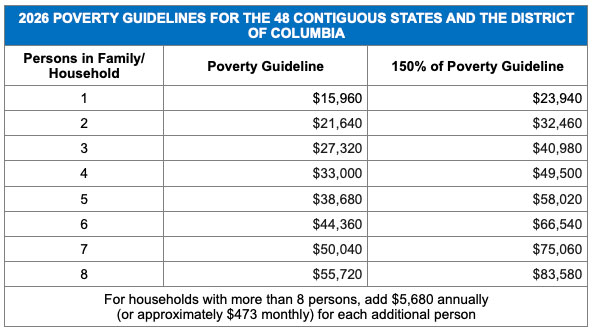
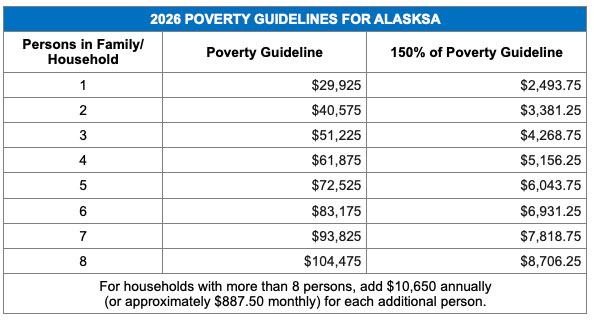
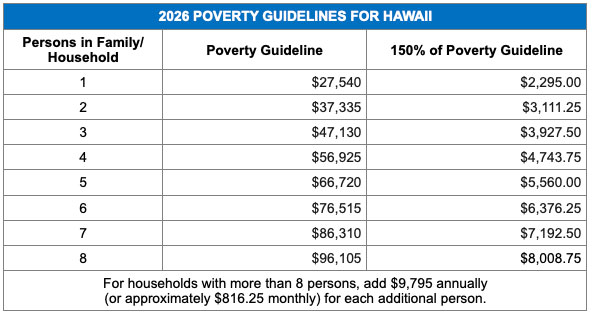
CCCF shall provide credit counseling services free of charge to any consumer who is under 150% of the poverty guidelines updated periodically in the Federal Register by the U.S. Department of Health and Human Services under the authority of 42 U.S.C. 9902(2). See table below:
3. Funding: CCCF receives funding from various city and state grant programs.
4. Upon request, CCCF will provide consumers with free bilingual counseling services or provide professional interpreter assistance to any limited English proficient consumer to ensure consumers are able to receive our services.
5. All CCCF credit counselors are required to be certified by a bona fide third-party certification provider that is accepted by all states in which credit counseling licensing is required prior to providing credit counseling services. Credit counselors are also required to undergo continuing education in order to meet certain state licensing requirements. All CCCF credit counselors are certified as certified personal finance counselors through one or more of the following agencies:
- FinCert.org (https://fincert.org/)
- Partnership for Financial Education (https://financialed.org)
6. CCCF’s credit counselors may discuss with consumers various options or recommendations during the course of their credit counseling session(s). These options or recommendations may include services, including filing for bankruptcy or entering to a Debt Repayment Plan (DRP), that could potentially have a negative impact on the consumer’s credit score.
7. CCCF shall not receive referral payments from any entity or persons for the referral of clients, nor shall it make payments to any entity or persons for the referral of clients, except under a fair share agreement.
8. CCCF has an obligation to, and is required to furnish clients with a certificate promptly upon completion of the counseling services provided to the client, and shall furnish the client with his or her certificate not later than 1 business day following the completion of counseling. Clients shall receive a certificate only upon completion of counseling.
9. Consumers will have the opportunity to negotiate an alternative payment schedule with regard to each unsecured consumer debt under terms as set forth in 11 U.S.C. § 502(k), which states that the court, on the motion of the debtor and after a hearing, may reduce a claim filed based in whole on an unsecured consumer debt by not more than 20 percent of the claim, if the claim was filed by a creditor who unreasonably refused to negotiate a reasonable alternative repayment schedule proposed on behalf of the debtor by an approved nonprofit budget and credit counseling agency and if the offer of the debtor was made at least 60 days before the date of the filing of the petition; and provided for payment of at least 60 percent of the amount of the debt over a period not to exceed the repayment period of the loan, or a reasonable extension thereof, and that no part of the debt under the alternative repayment schedule is non-dischargeable. The debtor shall have the burden of proving, by clear and convincing evidence, that the creditor unreasonably refused to consider the debtor’s proposal, and that the proposed alternative repayment schedule was made prior to expiration of the 60-day period. CCCF does provide this service to consumers, and consumers may incur additional fees as such where permitted by law.
10. The following information is important for you to consider before engaging in a debt management plan or filing for bankruptcy: Debt management plans and filing bankruptcy are not appropriate for all individuals, and you may ask us to provide information about other options for addressing your debts. CCCF is approved to issue certificates in compliance with the Bankruptcy Code. Such approval does not endorse or assure the quality of CCCF's services.
Participation in a debt management plan may have an adverse effect on your credit report and credit score. Creditors may report to consumer reporting agencies that your accounts are being repaid through a debt management plan, credit counseling program, or similar arrangement. In addition, creditors may close or suspend your ability to use existing credit accounts while you are participating in a debt management plan. The closure of accounts, reduction in available credit, changes in payment terms, or notation of participation in a debt management plan may negatively affect your credit score and may make it more difficult to obtain new credit, housing, insurance, employment, or favorable interest rates. The impact on your credit report and credit score will vary depending on your individual circumstances and the reporting practices of your creditors and consumer reporting agencies.
Filing bankruptcy may also have an adverse effect on your credit report and credit score and may make it more difficult to obtain credit, housing, insurance, employment, or favorable interest rates. Filing bankruptcy or participating in a debt management plan may not prevent litigation, garnishment, attachment, repossession, foreclosure, eviction, loss of employment, or other collection activity. Failure to make required payments to creditors may constitute a default under your agreements with creditors and may result in increased finance charges, collection efforts, or legal action.
CCCF is not a credit repair organization and does not represent or guarantee that participation in a debt management plan or filing bankruptcy will improve your credit score, credit history, or creditworthiness. A bankruptcy filing may remain on your credit report for up to 10 years, depending on the type of bankruptcy filed. Generally, a Chapter 7 bankruptcy may remain on your credit report for up to 10 years from the filing date, while a Chapter 13 bankruptcy may remain on your credit report for up to 7 years from the filing date. The existence of a bankruptcy on your credit report may adversely affect your credit score and your ability to obtain credit, housing, insurance, employment, or favorable interest rates.
11. CCCF may disclose client information to the United States Trustee in connection with the United States Trustee’s oversight of the Agency, or during the investigation of complaints, during on-site visits, or during quality of service reviews.
12. The United States Trustee has reviewed only CCCF’s credit counseling services and the United States Trustee has neither reviewed nor approved any other services the Agency provides to clients.